The Future of Work Platforms: How Financial Rails Will Define the Next Decade of Marketplaces
The next decade of marketplaces won’t be defined by who connects workers fastest — but by who pays, verifies, and rewards them best. Here’s how financial rails will power the future of work.
Marketplaces are growing up
Ten years ago, most gig platforms were scrappy experiments.
You had Uber figuring out driver payouts, Fiverr inventing the digital marketplace, and Airtasker introducing peer-to-peer jobs in Australia.
Today, marketplaces aren’t side projects — they’re core infrastructure for the global workforce.
Millions depend on them for income. Governments regulate them. Investors bet on them.
But here’s what’s quietly changing beneath the surface:
The future of work platforms won’t be defined by who matches the most people.
It’ll be defined by who builds better financial rails — faster, fairer, and more inclusive ones.
Work has become digital, but money hasn’t kept up
Work has gone global — yet payments are still stuck in the past.
A freelancer in Manila completes a project for a client in Melbourne, but waits five days for the payout.
A courier in Mumbai finishes a shift, but can’t access earnings until Monday.
In 2025, that’s still the norm.
That delay, friction, and lack of transparency create a new kind of inequality — financial lag.
Marketplaces may be digital, but their money movement still depends on old-school rails — banks, batch processing, and intermediaries.
That’s why the next generation of marketplaces are rethinking their DNA — embedding finance at the core, not as an afterthought.
The Shift: From platforms to financial ecosystems
If you look closely at the most successful marketplaces today — from Deel and Upwork to Gojek and Flip — they’ve all evolved beyond “matching supply and demand.”
They’ve become financial ecosystems.
They don’t just help people find work; they help them get paid, save, and grow.
Here’s what that shift looks like:
- Payments are instant (early pay or real-time payouts).
- Workers have in-app wallets, cards, or micro-savings.
- KYC and verification happen in seconds, not weeks.
- Tax, insurance, and compliance are automated behind the scenes.
- Marketplaces earn revenue from every transaction, not just commissions.
That’s not a fintech pivot.
That’s the evolution of work itself.
The New Backbone: Financial Rails
In simple terms, financial rails are the invisible infrastructure that moves money between people, platforms, and institutions — securely, instantly, and compliantly.
They’re what make embedded finance possible.
Think of them like this:
If your marketplace is the city, financial rails are the roads — every job, payment, and reward travels on them.
But the new generation of rails — the ones built for marketplaces — look very different from legacy banking systems.
Traditional rails
- Slow, batch-based settlements
- Rigid compliance processes
- Limited to single currencies and local banks
Modern embedded rails
- Real-time global transfers
- API-based KYC & AML
- Multi-currency wallets & FX optimisation
- Smart routing for payouts and rewards
This evolution is what platforms like MyGigsters are enabling — not by replacing banks, but by abstracting away the friction so marketplaces can focus on users, not ledgers.
The Trendline: Where the next decade is heading
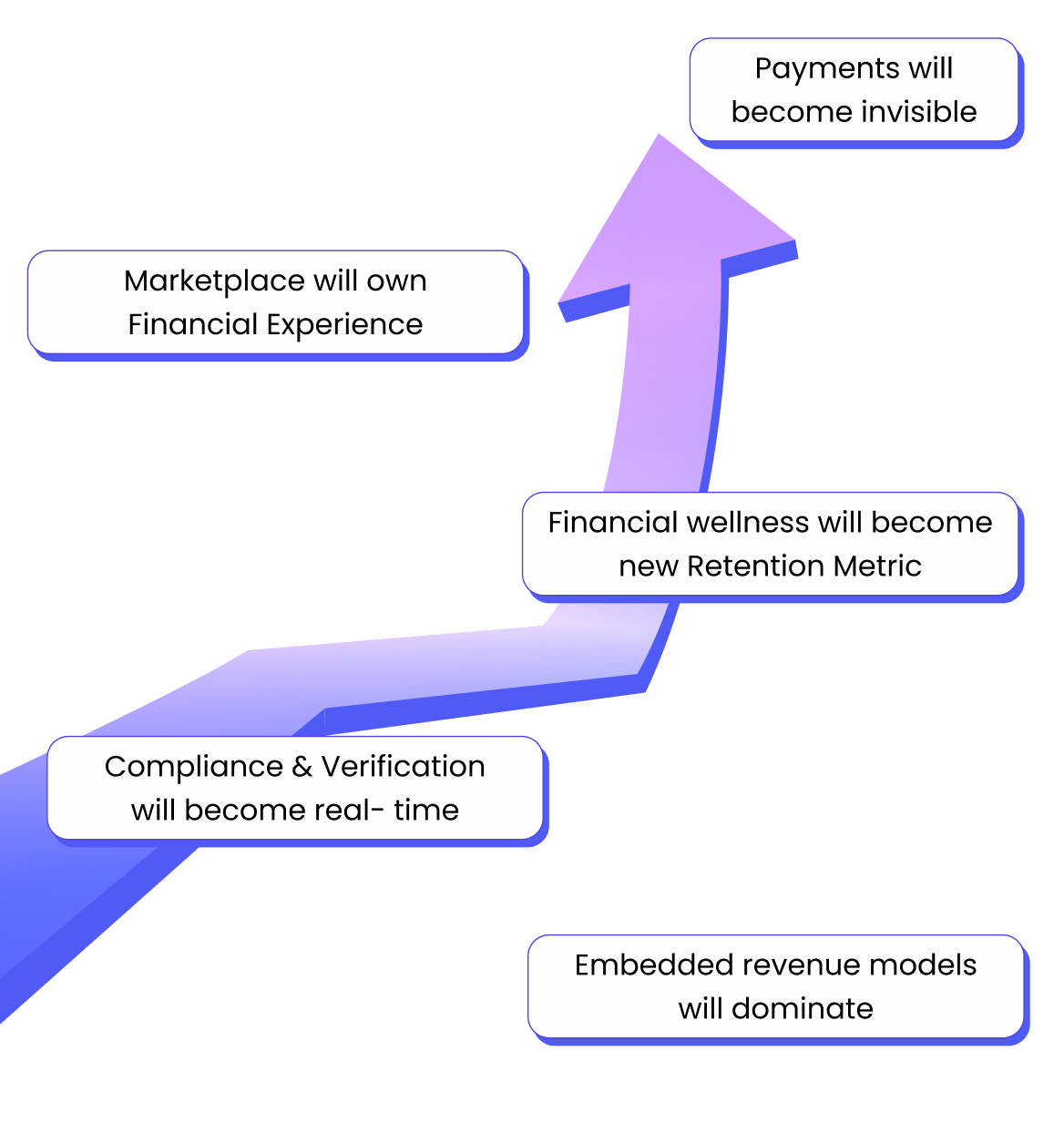
Here’s what’s already unfolding across the gig economy and where it’s heading by 2030 👇
1. Payments will become invisible
Money movement will fade into the background.
Workers will finish a task and see funds appear instantly in their wallet — no banking delays, no weekend holds.
Payment speed will become a trust signal, not just a convenience.
2. Marketplaces will own the financial experience
Instead of outsourcing payments to third parties, platforms will embed financial tools — wallets, credit, and insurance — directly into their workflow.
Owning the payment flow = owning the loyalty loop.
3. Financial wellness will become the new retention metric
Marketplaces will compete not on who pays more, but on who supports worker success better — offering tools to save, manage, and grow money.
Platforms that promote financial wellbeing will see churn drop and lifetime value rise.
4. Compliance and verification will become real-time
Identity checks, AML screening, and cross-border regulations will all move to automated APIs.
Manual onboarding and document collection will vanish.
The best platforms will be borderless and compliant by design.
5. Embedded revenue models will dominate
By 2030, marketplaces will monetise the financial layer itself — earning from:
- Instant payout fees
- FX margins
- Card interchange
- Embedded credit and insurance
Finance will no longer be a cost line — it’ll be a revenue multiplier.
The Founder’s Reality: Scaling without financial friction
Ask any founder scaling a two-sided marketplace — payments are often the first thing that break.
When you’re handling thousands of transactions a week, spread across multiple geographies and payment methods, even small inefficiencies compound fast.
The good news?
We now have the infrastructure to automate, orchestrate, and monetise every dollar that moves through your platform.
That’s what platforms like MyGigsters are helping founders do:
- Build custom payout flows that match your use case
- Automate KYC, compliance, and tax obligations
- Enable instant worker payouts and multi-currency wallets
- Embed financial rewards and early pay options
— all through one API layer.
That’s how you go from manual ops to financial-grade scalability.
The Bigger Picture: The next decade of marketplaces
If the 2010s were about connecting people to opportunities,
The 2020s — and beyond — will be about connecting people to financial inclusion.
The lines between fintech, SaaS, and marketplaces are already blurring.
In the next decade:
- Every marketplace will behave like a fintech.
- Every fintech will become a marketplace.
- And every user will expect instant, transparent, and global financial experiences.
The winners won’t be the ones who build the fanciest apps — they’ll be the ones who build the strongest financial foundations.
Final Thought
The future of work will run on financial rails — not spreadsheets, not gateways, not manual banking.
These rails will power the new social contract between platforms and workers: one built on speed, trust, and empowerment.
And when that happens, marketplaces will no longer just connect work.
They’ll connect prosperity.
FAQs
1. What are financial rails in the context of marketplaces?
They’re the embedded systems that handle payments, payouts, KYC, and compliance within a platform — enabling seamless money movement.
2. Why are financial rails important for the future of work platforms?
Because trust and retention depend on reliable, transparent, and fast financial experiences — not just good matching algorithms.
3. How can a marketplace start embedding these rails?
By partnering with providers like MyGigsters, who offer API-ready financial infrastructure that integrates payments, compliance, and early pay.
4. Will all marketplaces become fintechs?
Not literally — but they’ll all operate like fintechs, with finance embedded at the core of their user experience.
👉 Discover how MyGigsters powers the next generation of marketplaces with embedded financial rails — helping platforms scale faster, stay compliant, and build trust at every transaction."