Embedded Finance Infrastructure: The Backbone of Scalable Marketplaces
The next generation of marketplaces won’t scale on tech alone — they’ll scale on embedded finance. Here’s why financial infrastructure is now the backbone of every successful platform.
Growth pain no one talks about
A few months ago, I caught up with a marketplace founder over coffee.
They’d just hit a huge milestone — 10,000 active users and $25 million in GMV.
But instead of celebrating, they looked exhausted.
“Our product is solid, Benji. But we’ve outgrown our payments stack. Every new user means more reconciliation, more payout delays, and more manual admin.”
Sound familiar?
It’s a story I hear often — marketplaces that find product-market fit, then get stuck in financial bottlenecks.
They’ve nailed matching supply and demand, but their financial infrastructure can’t keep up.
That’s when it becomes clear:
Tech gets you started.
Embedded finance infrastructure helps you scale.
Marketplaces are no longer just transaction platforms
Today’s marketplaces aren’t just digital middlemen — they’re financial ecosystems.
Every booking, job, or delivery is a mini-transaction involving:
- Payments in
- Splits and fees
- Payouts out
- Tax, compliance, and reporting
Multiply that by hundreds of thousands of users and dozens of currencies, and suddenly you’re not just running a tech platform — you’re running a financial network.
The catch?
Most founders still rely on patchwork banking tools or basic gateways like Stripe Connect.
They weren’t built for multi-party, cross-border, compliance-heavy marketplaces.
That’s where embedded finance infrastructure steps in — providing the rails for scale.
What exactly is embedded finance infrastructure?
At its core, embedded finance infrastructure means integrating banking-level functionality — payments, wallets, compliance, FX, and lending — directly into your platform.
Think of it as the plumbing behind your user experience.
It lets you:
- Accept payments seamlessly
- Hold funds securely in wallets
- Split and route payouts instantly
- Verify users (KYC/AML) automatically
- Manage currencies, taxes, and compliance
— all without leaving your platform.
It’s what turns your marketplace from a product into a financial engine.
The Why: Scaling marketplaces need more than software
Here’s the brutal truth:
Software alone doesn’t scale marketplaces — infrastructure does.
When you grow from 100 to 10,000 users, your biggest risks aren’t UX bugs or app crashes.
They’re:
- Payout errors
- Compliance gaps
- Liquidity constraints
- Cross-border complexity
Every growth milestone adds financial complexity.
And without robust embedded finance infrastructure, those cracks become breaking points.
That’s why the fastest-growing platforms — in logistics, healthcare, freelance, and delivery — are building their core operations on top of embedded finance rails.
The Benefits: Why founders are embedding finance early
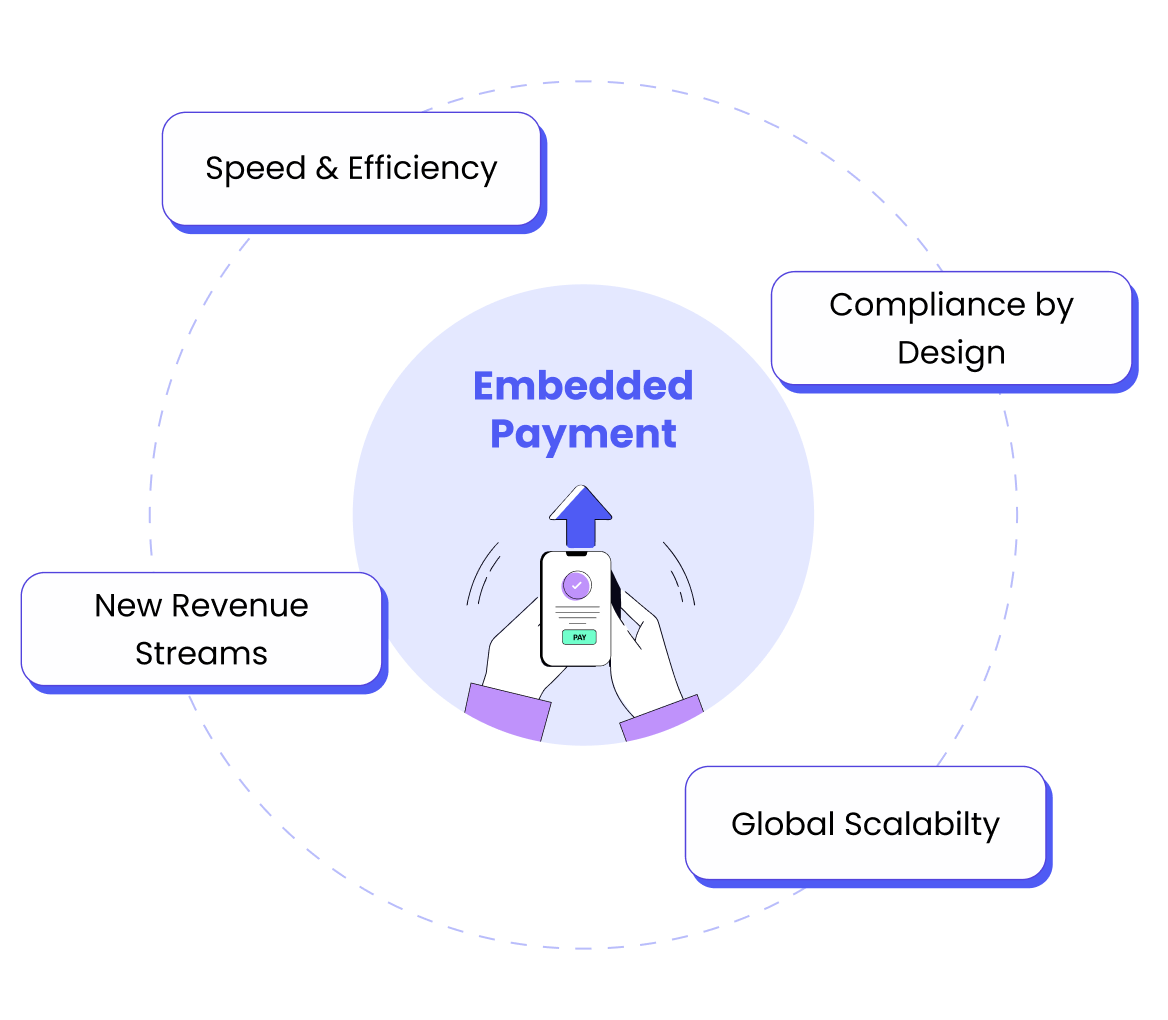
Let’s break down the four biggest reasons marketplaces are adopting embedded finance infrastructure early:
1. Speed and efficiency
Automated payments, reconciliation, and compliance workflows mean your ops team doesn’t drown in spreadsheets.
Scaling from 100 to 10,000 users becomes a workflow change, not a hiring spree.
2. Compliance by design
Built-in KYC, AML, and transaction screening keep you compliant as you scale — without lawyers reviewing every new user.
3. Global scalability
Multi-currency wallets and FX management let you onboard users anywhere.
You’re not limited by borders or local banking quirks.
4. New revenue streams
Once you control payment flows, you can monetise them:
- Instant payout fees
- FX spreads
- Wallet interchange
- Embedded credit or insurance
Finance becomes not just a cost centre, but a profit driver.
Example: How embedded finance powers real marketplaces
Here’s a simple example from one of our partners:
A creative freelance marketplace was struggling with slow payouts and manual invoices.
They integrated MyGigsters’ Orbit Suite, embedding early pay, split payments, and KYC onboarding.
The results:
- Payout time dropped from 3 days to under 3 minutes.
- Compliance approvals became instant and auditable.
- Platform revenue increased by 4x via monetised payment flows.
- And worker retention improved because earnings felt predictable and professional.
They didn’t build a bank.
They just built on top of one — with embedded finance as the layer.
The Architecture: What a scalable marketplace stack looks like
Let’s visualise the anatomy of a modern, scalable marketplace:
When you get the financial layer right, everything above it scales faster and cleaner.
It’s the difference between hustle growth and infrastructure-led growth.
The Founder’s Lens: Building on strong rails
Every founder faces a choice once their marketplace starts taking off:
Do you keep hacking payments with duct tape — or do you invest in a system that scales with you?
Here’s what I tell founders:
“You can’t scale chaos. You can only scale systems.”
Embedded finance isn’t just a tech upgrade — it’s an operational unlock.
It lets you:
- Move faster without breaking compliance
- Launch new business models (like subscriptions or early pay)
- Offer a seamless, bank-grade experience without building a bank
It’s what separates marketplaces that survive from those that truly scale.
The Future: Marketplaces as financial ecosystems
Five years from now, every major marketplace will look like a fintech.
Not because they want to be banks, but because finance is where user trust lives.
Workers, suppliers, and customers will all expect:
- Instant payouts
- Transparent fees
- In-app wallets and financial tools
- Localised currency support
Platforms that can’t deliver that won’t keep up.
Embedded finance infrastructure isn’t optional anymore — it’s the backbone of scalable marketplaces.
FAQs
1. What is embedded finance infrastructure?
It’s the set of financial tools and APIs that allow platforms to handle payments, payouts, KYC, and compliance directly within their systems.
2. Why is it essential for scalability?
Because manual banking, third-party gateways, and disconnected systems slow down growth and increase regulatory risk as marketplaces expand.
3. What kind of marketplaces benefit most?
Freelance, delivery, healthcare, logistics, and B2B service marketplaces — any model where multiple parties exchange value.
4. How can a startup access embedded finance infrastructure?
By partnering with providers like MyGigsters, who deliver licensed, API-ready infrastructure backed by Airwallex to handle global payments, KYC, and compliance.
👉 Discover how MyGigsters powers marketplaces with embedded finance infrastructure — from instant payouts to automated compliance — so you can scale faster and smarter."