

Why Superannuation is Key for Independent Workers and Gig Workers in Australia

Why Superannuation is Key for Independent Workers and Gig Workers in Australia
I've worked 19 different gigs throughout my career. From freelance writing to Uber driving, from consulting to running my own startup — I've seen the gig economy from every angle. And here's what I learned the hard way: if you're working independently, superannuation isn't just important — it's your financial lifeline.
The harsh reality? Most gig workers are sleepwalking toward a retirement crisis. While traditional employees have super contributions automatically deducted from every paycheck, independent workers often fall through the cracks. But here's the thing many don't realize: a significant portion of gig workers are actually entitled to super under Australian law.
The Retirement Gap is Real — And Getting Worse
Let's talk numbers. The average Australian retires with around $270,000 in superannuation. Sounds reasonable until you realize that's barely enough to fund a modest retirement for 10-15 years. Now imagine you're a gig worker who's missed super contributions for chunks of your career.
Missing just $2,000 in super contributions annually over a 20-year period doesn't just cost you $40,000 — it costs you approximately $90,000 in retirement savings due to compound interest. For many gig workers, the gap is far larger.
I remember chatting with a delivery driver who'd been working platforms for five years. Great income, loved the flexibility, but zero super contributions. He was shocked when I showed him he'd potentially missed out on $15,000+ in employer contributions — money that should have been working for his retirement.
Understanding the Super Guarantee: It's Not Just for ""Employees""
Here's where things get interesting. The Super Guarantee (SG) — now at 12% as of 1 July 2025 — doesn't just apply to traditional employees. Many gig workers and independent contractors are actually entitled to super contributions, but both workers and platforms often don't realize it.
What is the Super Guarantee?
The Super Guarantee requires employers to pay superannuation contributions for eligible workers. The current rate is 12% of ordinary time earnings (as of 1 July 2025). And here's a change many people missed: the old $450 per month minimum threshold was removed in July 2022. That means there's no longer a minimum earning requirement — if you're eligible, you're entitled to super from the first dollar.
But here's the crucial part: eligibility isn't determined by your job title or how you're classified by the platform. It's determined by the nature of your work relationship.
The Employee vs Contractor Test: What Every Gig Worker Needs to Know
In 2022, two landmark High Court decisions — CFMMEU v Personnel Contracting and ZG Operations v Jamsek — fundamentally changed how worker classification works in Australia. The key shift: classification is now based on the legal rights and obligations in your contract, not the practical reality of how work is performed day-to-day.
This matters because any label in your contract (like ""independent contractor"") doesn't determine your classification. What matters is what the contract actually says about control, risk, delegation, and how the work fits into the business.
The ATO uses several indicia to determine whether a worker is an employee (entitled to super) or a genuine independent contractor (generally not entitled). No single factor is determinative — they must be considered together.
Key Determination Factors (ATO Indicia):
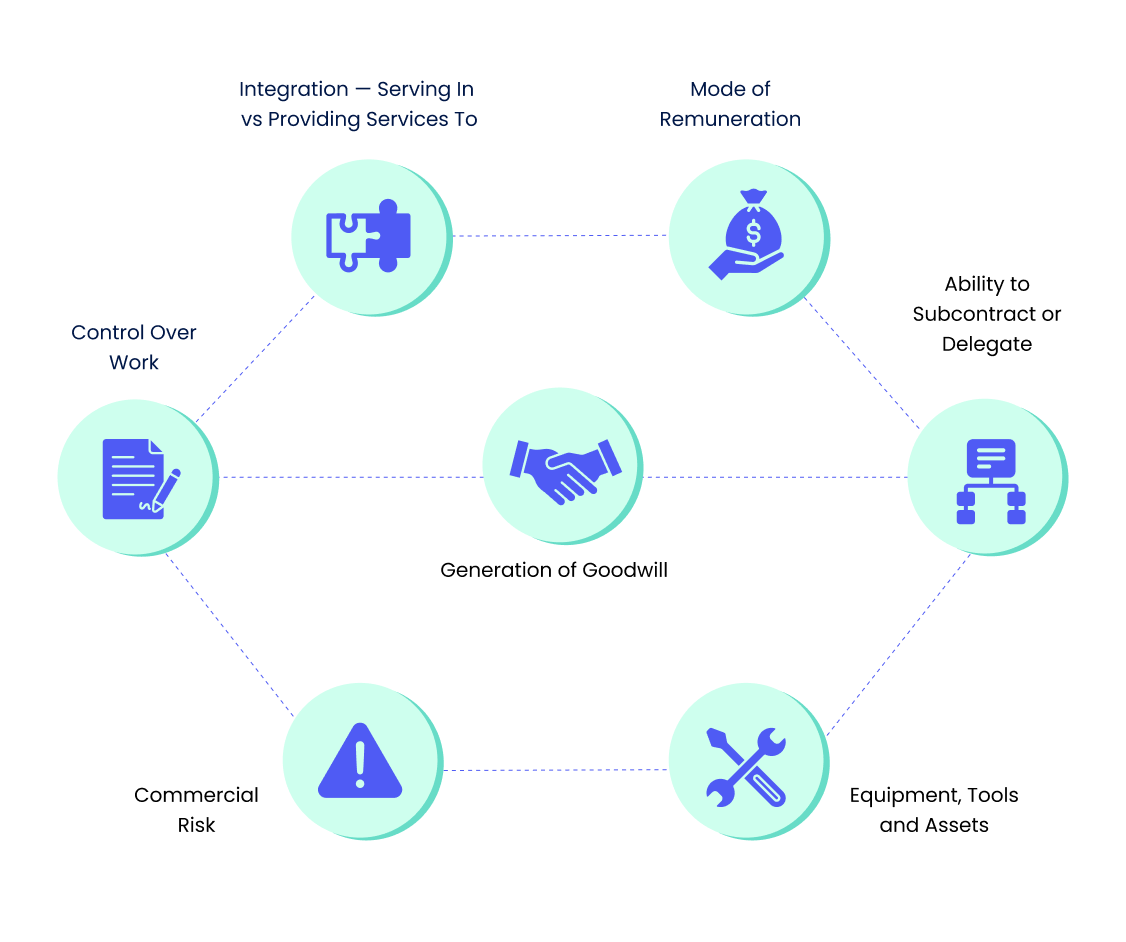
1. Control Over Work
- Does the contract give the business the right to control how, when, and where work is done?
- Or can the worker choose how they perform the work, subject only to reasonable direction?
2. Integration — Serving In vs Providing Services To
- Does the worker serve in your business, performing work as a representative of your business? (Employee)
- Or does the worker provide services to your business, performing work to further their own business? (Contractor)
3. Mode of Remuneration
- Is the worker paid for time worked, per item/activity, or by commission? (Points to employee)
- Or is the worker contracted to achieve a specific result and paid a fixed fee on completion? (Points to contractor)
4. Ability to Subcontract or Delegate
- Does the contract prevent the worker from delegating or subcontracting the work? (Employee)
- Or does the contract allow the worker to pay someone else to do the work for them? (Contractor — but the clause must be genuine, not a sham)
5. Equipment, Tools and Assets
- Does the business provide all or most of the equipment, tools, or reimburse the worker for them? (Employee)
- Or does the worker provide their own equipment without reimbursement? (Contractor)
6. Commercial Risk
- Does the worker bear little or no financial risk, with the business covering costs from defects? (Employee)
- Or does the worker bear the commercial risk for costs arising from injury or defect in their work? (Contractor)
7. Generation of Goodwill
- Does the business benefit from any goodwill generated by the worker's efforts? (Employee)
- Or does the worker's own business benefit from the goodwill? (Contractor)
Important Structural Rules
Some workers are always employees regardless of contract terms: apprentices, trainees, labourers, and trades assistants.
Companies, trusts, and partnerships are always contractors. If you've hired a company or trust to do the work, that entity is the contractor — even if an individual person does the actual work.
The ""Mainly for Labour"" Test — Super for Certain Contractors
Even if a worker is classified as a genuine independent contractor, super obligations may still apply. You must pay super for independent contractors who work under a contract that is wholly or principally for their labour.
For example:
- Super likely applies: A delivery driver engaged as a contractor, paid per delivery, where the contract is principally for their personal labour
- Super unlikely applies: A freelance design firm (registered company) contracted to deliver a complete brand identity package for a fixed project fee
Self-Assessment Framework: Am I Entitled to Super?
Review your contract and ask these questions about what it says — not just what happens in practice:
- Control: Does the contract give the platform the right to control how, when, and where you work? (Yes = points to employee)
- Integration: Does the contract require you to serve in and represent the platform's business? (Yes = points to employee)
- Remuneration: Are you paid for your time or per task, rather than a fixed fee for a specific result? (Yes = points to employee)
- Delegation: Does the contract prevent you from subcontracting or delegating the work to someone else? (Yes = points to employee)
- Equipment: Does the platform provide or reimburse the tools and equipment you need? (Yes = points to employee)
- Risk: Does the platform bear the financial risk if something goes wrong with the work? (Yes = points to employee)
- Goodwill: Does the platform (not you) benefit from the goodwill your work generates? (Yes = points to employee)
If most answers point to ""employee,"" you may be entitled to super. Even if the overall picture says ""contractor,"" check the ""mainly for labour"" test — if your contract is principally for your personal labour, super may still apply.
Remember: no single factor decides it, and labels in the contract don't matter. Use the ATO's official decision tool for a more detailed assessment.
Recent Legislative Changes: Payday Super is Coming
The regulatory landscape is shifting fast — and platforms need to pay attention.
Payday Super (from 1 July 2026): The Australian Government is introducing a major reform requiring employers to pay super contributions at the same time as salary and wages — not quarterly. This means platforms can no longer batch super payments at the end of the quarter. Super must flow with every pay run, within seven business days of payday. Non-compliance triggers the new Super Guarantee Charge (SGC) with penalties.
The ATO's Small Business Superannuation Clearing House (SBSCH) is closing permanently on 1 July 2026 as part of this reform. Businesses will need to move to commercial clearing house providers.
The ATO has also been increasingly focused on clarifying gig worker entitlements. Recent guidance emphasizes that:
- Contract labels like ""independent contractor"" don't determine the legal classification — the actual rights and obligations in the contract do
- Multiple factors (indicia) must be considered together, not in isolation — no single factor is determinative
- Platforms are responsible for correctly classifying workers and face penalties for getting it wrong
- The ATO provides a Super Guarantee Eligibility Decision Tool to help determine worker status
- Penalties apply for non-compliance with Super Guarantee obligations
What This Means for Workers
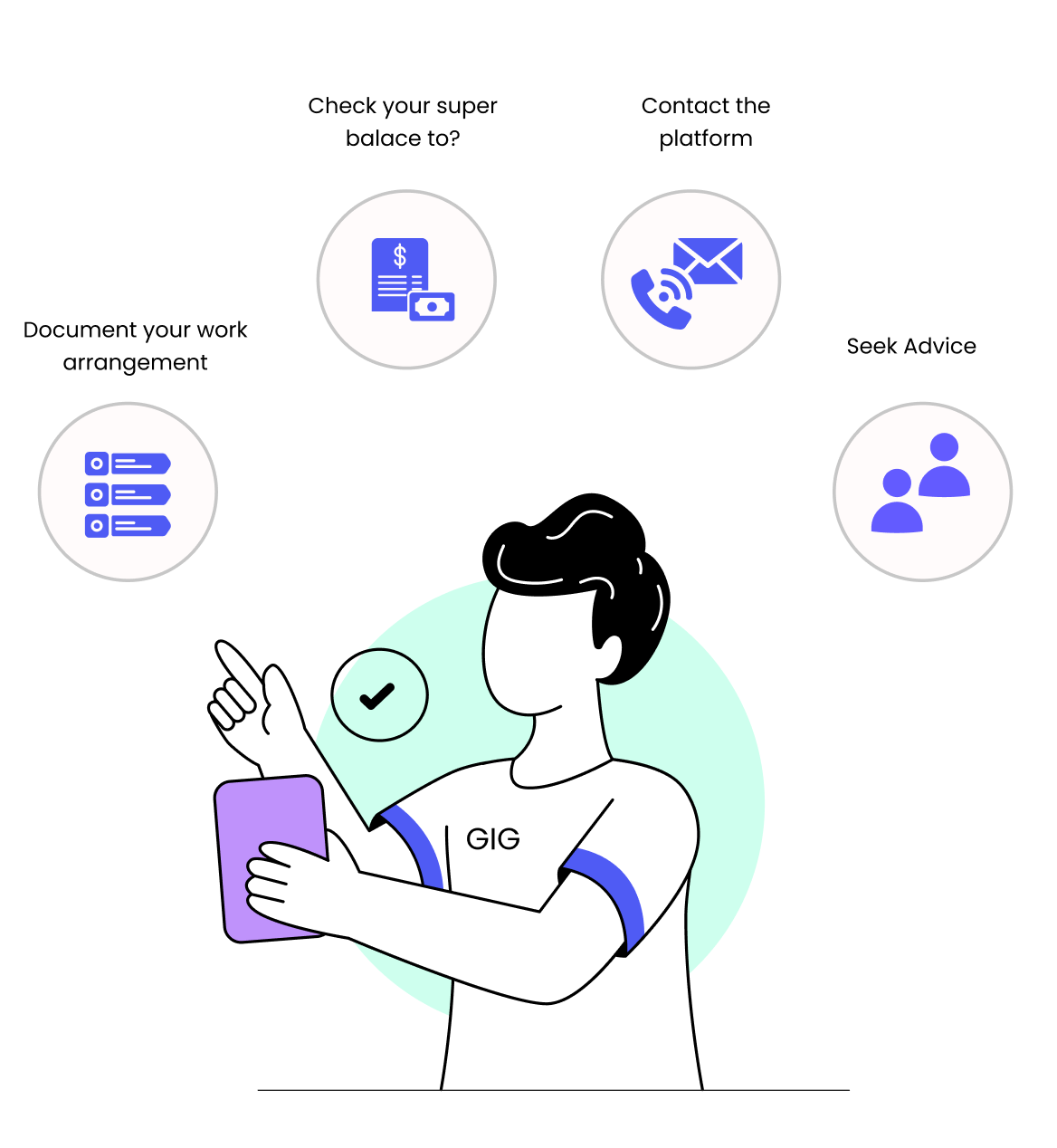
If you're a gig worker who believes you should be receiving super:
- Document your work arrangement — keep records of how the platform controls your work
- Check your super balance — are you receiving contributions you're entitled to?
- Contact the platform — many are willing to review classifications when presented with evidence
- Seek advice — the ATO provides guidance, and professional advice may be worthwhile for significant amounts
What This Means for Platforms
For platforms operating in Australia, getting worker classification wrong isn't just about compliance — it's about competitive advantage. Platforms that proactively address super obligations:
- Build stronger worker relationships and retention
- Reduce regulatory risk and potential penalties
- Create clearer value propositions for both workers and customers
- Future-proof their business model against regulatory change
The Technology Solution: Automating Super Compliance
This is where technology can solve a complex problem. Rather than leaving individual workers to navigate classification questions or pursue missed entitlements retroactively, platforms can build super compliance into their payment systems from day one.
With Payday Super launching in July 2026 and the ATO's free clearing house closing, this isn't a future problem — it's an immediate one.
At MyGigsters, we've built embedded super payments directly into our payment orchestration infrastructure. Through our partnership with SuperChoice — Australia's market-leading superannuation clearing house — platforms can automate super compliance end-to-end. Worker classification assessment, contribution calculation, and payments to the correct super fund all happen automatically as part of the existing payment flow.
When a worker meets the criteria for super entitlements, contributions flow with every pay run — exactly what Payday Super requires. No manual processes, no workers falling through cracks, no last-minute quarterly scrambles, no compliance headaches.
For workers, it means your retirement savings grow consistently with every payment, regardless of how many platforms you work across. For platforms, it means you're Payday Super-ready from day one, with competitive advantage through superior worker value propositions and reduced regulatory risk.
The Bottom Line
Superannuation isn't optional for eligible gig workers — it's a legal entitlement. The complexity comes from determining eligibility, not from the obligation itself.
If you're working in the gig economy, don't assume you're not entitled to super. Many platforms are already paying super to workers who meet the criteria. The key is understanding whether your work arrangement qualifies.
For platforms, the choice is simple: get ahead of this issue proactively, or deal with it retroactively. The former builds competitive advantage; the latter creates liability.
The gig economy isn't going anywhere. But neither are retirement planning needs. The platforms that recognize this and act accordingly will build more sustainable, worker-friendly business models that benefit everyone.
Frequently Asked Questions
Q: Do all gig workers get superannuation?
No, only those classified as employees based on the legal rights and obligations in their contract. The ATO considers factors like control, integration, remuneration mode, delegation rights, equipment, risk, and goodwill. Even genuine contractors may be owed super if their contract is principally for their personal labour.
Q: Does my contract calling me an ""independent contractor"" mean I'm not entitled to super?
No. Following the 2022 High Court decisions, labels in the contract are irrelevant. What matters is the actual legal rights and obligations the contract creates — things like who controls the work, who bears the risk, and whether you can delegate.
Q: Are companies or trusts ever classified as employees?
No. If you've engaged a company, trust, or partnership to do the work, that entity is always treated as a contractor for tax and super purposes, even if an individual person performs the work.
Q: What's the current Super Guarantee rate?
12% of ordinary time earnings as of 1 July 2025. The old $450/month minimum earning threshold was removed in July 2022, so there's no minimum — eligible workers receive super from the first dollar.
Q: Can I work for multiple platforms and still get super?
Yes, each platform relationship is assessed separately. You could be entitled to super from some platforms but not others, depending on the work arrangements.
Q: What should I do if I think I'm entitled to super but not receiving it?
Document your work arrangement, contact the platform first, and consider seeking advice from the ATO or a professional adviser if significant amounts are involved.
Q: What is Payday Super and when does it start?
From 1 July 2026, employers must pay super contributions at the same time as wages (within seven business days of payday), rather than quarterly. Non-compliance triggers the new Super Guarantee Charge with penalties.
Q: How do automated super payment systems work for platforms?
Services like MyGigsters, in partnership with SuperChoice (Australia's leading clearing house), embed super assessment and payment into existing payment flows — automatically calculating contributions and routing them to the correct super fund with every pay run.
This article provides general guidance only and shouldn't be considered professional financial or legal advice. For specific situations, consult qualified professionals and refer to current ATO guidelines."
